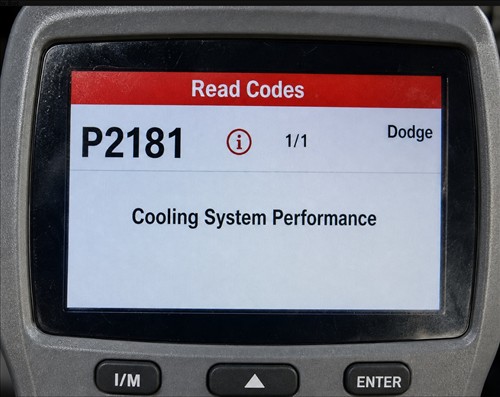
If you have a Dodge with a P2181 OBDII code, there is a problem with the cooling system performance.
The onboard computer (PCM) is seeing the engine coolant temperature change too slow or too fast compared to what it expects.
What is a Dodge P2181 OBDII Code?
A P2181 OBDII code is a “Cooling System Performance” error.
When the onboard computer (PCM) detects the coolant temperature is too hot, too cold, or not changing at the right rate, it will give a P2181 trouble code.
On a Dodge, the PCM predicts what the coolant temperature should be based on the start-up temperature, outside temperature, and how the vehicle is being driven. It then compares that to the engine coolant temperature sensor.
If the temperature changes too slow or too fast, it will set a P2181. It is a two-trip code on Dodge, so it may take two drive cycles for the check engine light to stay on.
Several components work together to keep an engine at the right temperature, with each needing to be checked for failure.
A P2181 can be caused by overheating, but it is also very often caused by the engine staying too cold or warming up too slow.
A related code is P0128, which is coolant temperature below thermostat regulating temperature. If you have P2181 and P0128 together, start with the thermostat and coolant level.
8 Causes and Fixes for P2181 Code Dodge
- Engine Coolant Temperature Sensor
- Radiator Coolant Temperature Sensor
- Engine Coolant Low
- Thermostat
- Water Pump
- Radiator Fan
- Clogged Radiator
- Head Gasket
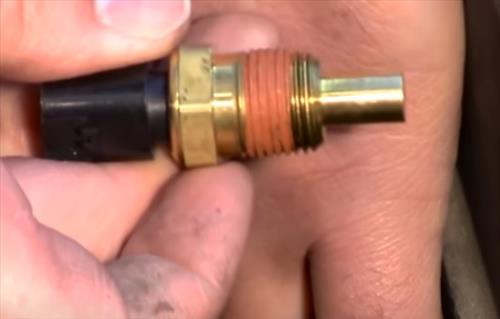
The engine coolant temperature sensor (ECT) is the sensor that reports the engine temperature to the onboard computer (PCM).
If it goes bad or has a bad connection, it will cause a P2181 error code.
The sensors can be tested to see if they are good or bad with a multimeter or simply replaced as a low-cost item.
The voltage can also be tested at the wiring harness to see if there is an open or high resistance in a wire. A bad ground or damaged connector at the ECT will set the same code as a bad sensor.
Here is how to test and replace an engine temperature sensor.
Some Dodges, mainly newer models, also have a radiator coolant temperature sensor.
It monitors the temperature inside the radiator, and if it goes bad can cause issues.
Most older Dodges will not have this sensor, while newer Dodge cars and trucks often will have it.
If this sensor is on the vehicle, it should be checked, but on Dodge the P2181 code is mainly set by comparing the predicted engine temperature to the engine coolant temperature sensor.
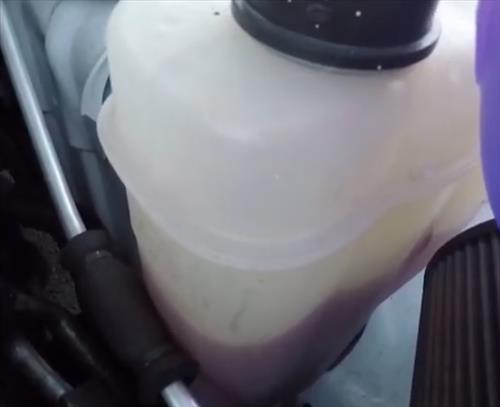
If the coolant level is low, the engine can overheat or the sensor can read the wrong temperature and cause a P2181.
Check the fluid levels with a cold engine and be sure it is at the correct level needed.
Air trapped in the cooling system after a refill can also make the temperature reading jump around. Bleed the system after any coolant work.
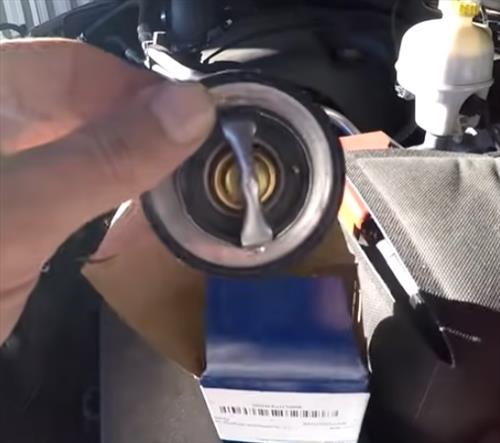
The thermostat regulates the coolant temperature by mechanically opening and shutting as needed.
When the vehicle is cold, it stays shut, allowing the engine to warm up faster.
As the engine heats up, the thermostat slowly opens, allowing fluid to pass and begin to be cooled by the radiator.
When the thermostat fails and becomes stuck closed, the engine will heat up and not cool properly.
When the thermostat is stuck open, the engine will stay too cold or take too long to warm up. That is a very common cause of a P2181 on a Dodge, even if the gauge never shows overheating.
On many 3.6 engines the thermostat is in a plastic housing that cracks and leaks. Replace the housing and thermostat as a unit on those engines.
A cheap aftermarket thermostat that opens too soon can also set this code.
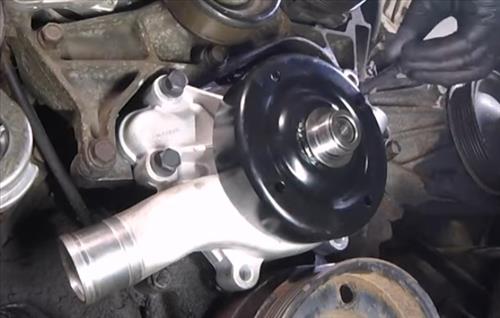
A water pump keeps coolant flowing through an engine and radiator, which cools the engine.
When the pump fails, the vehicle will overheat quickly and cause a P2181 trouble code.
Water pumps will often leak when they go bad with a small drip at the bottom of the unit.
The radiator fan blows air through the radiator cooling the coolant as it flows inside.
When there is no airflow, the car or truck will start to overheat when stopped or moving slowly.
If the vehicle stays cool when driving over 20-30 MPH but overheats when stopped, the radiator fan is likely failing.
A fan that runs all the time can also keep the engine too cold and set a P2181.
A radiator can become clogged up with age and need to be flushed.
When a radiator is clogged, it can cause overheating.
There are flush kits that can be bought to help flush out any debris inside. Here is how to use a radiator flush kit.
In some cases, the radiator may need to be replaced.
In some rare cases, a bad head gasket can cause overheating and a P2181 OBDII error code.
While not common, it is something to keep in mind for a hard to troubleshooting vehicle that keeps overheating.
Summary
A Dodge with a P2181 OBDII code is having a cooling system performance problem. The engine is too hot, too cold, or not changing temperature at the rate the PCM expects.
If the vehicle is not overheating, it is often a stuck open thermostat or a bad coolant temperature sensor.
Check the coolant level first. Then test or replace the thermostat, and check the engine coolant temperature sensor and wiring.
On many 3.6 Dodges, the plastic thermostat housing is a common failure.
On newer Dodges, there may also be a radiator coolant sensor that should be checked.
The radiator fan and water pump can also cause overheating problems if they go bad.
If the radiator is clogged with debris, it can be flushed or replaced.
Have you had issues with a P2181 OBDII code in a Dodge? Let us know your thoughts below.