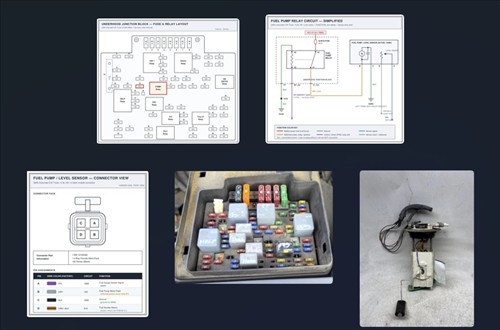
2000 Chevy GMC 5.3L Fuel Pump Circuit
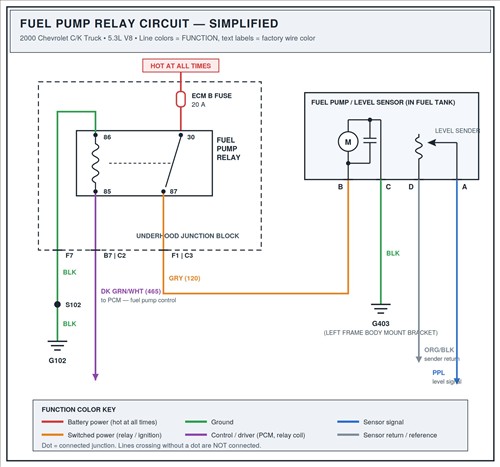
HPower starts at the ECM B fuse, a 20-amp in the underhood junction block that’s hot at all times. It feeds pin 30 of the fuel pump relay. The relay’s coil has two sides: one goes to ground (the black wire out terminal F7), and the other — circuit 465, dark green with a white stripe — comes from the PCM. When the PCM puts 12 volts on 465, the relay clicks, and battery power flows out pin 87 onto the gray wire, circuit 120, headed for the tank.
The line colors in these drawings show function, not the actual insulation color. Red is constant battery power, orange is switched power, green is ground, purple is PCM control, blue is a sensor signal. The factory wire colors are printed as text labels on each line, so you can still match the drawing to what’s in your hand.
2000 Chevy GMC 5.3L Fuel Pump Relay and Fuse Location
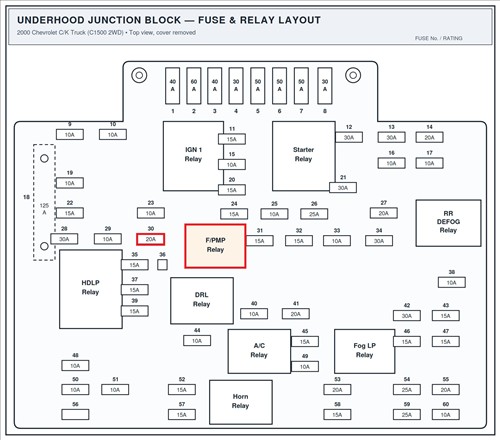
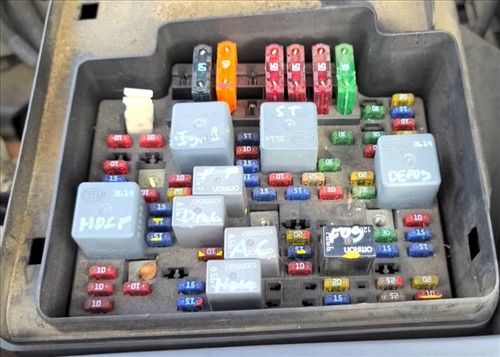
The two boxes outlined in red are your first two checks: the 20-amp fuse and the F/PMP relay right beside it. Pull the fuse and look at it in the light. Then try the relay swap trick — the horn relay and A/C relay in the same box are the identical part, so trade one in and see if the pump wakes up. Costs nothing, takes two minutes, and rules out the most common failure.
OEM Fuel Pump Relay – 2000 Chevy Silverado / GMC Sierra 1500 5.3L
- OEM fuel pump relay is a standard 12V ISO micro relay supplied by GM.
- Original manufacturers were typically Tyco Electronics (formerly Potter & Brumfield) or Omron.
- GM used multiple approved suppliers depending on production plant and build date.
OEM GM Part Numbers
- 12193613 (Original)
- 19118886 (Superseded GM service part)
- 13503102 / 13500126 (Newer GM multi-purpose relay that supersedes earlier part numbers)
Relay Specifications
- 12-Volt
- 4-Pin ISO Micro Relay
- Normally Open (SPST)
- 30/40 Amp Rating
Common Relay Markings
- Tyco V23134-…
- Omron G8JN-…
- GM 12193613 or one of the superseding GM part numbers
Aftermarket Cross-Reference Part Numbers
- ACDelco D1780C
- Bosch 0 332 019 150 (or equivalent 4-pin Bosch-style relay)
- Standard Motor Products RY-612
- WVE / Intermotor 1R1495
OEM Fuel Pump Relay on Amazon
GM Genuine Parts 15-81106 (13503103) Multi-Purpose Relay
2000 Chevy GMC 5.3L Fuel Pump Pins

One connector handles everything at the tank — GM part 12160482, a 4-way Metri-Pack 150. Four pins:
- Pin B — gray, circuit 120. Pump power. This is where you check for that two-second shot of 12 volts at key-on.
- Pin C — black, circuit 1650. Ground, running to G403, a stud on the left frame body-mount bracket. A rusty G403 kills more pumps than people think, and it’ll do it intermittently, which is worse.
- Pin A — purple, circuit 1589. The gas gauge signal.
- Pin D — orange with a black stripe, circuit 510. The sender return back to the PCM.
If you’ve got 12 volts on B and a clean ground on C during the prime pulse and the pump still doesn’t spin, the pump’s done.
2000 Chevy GMC 5.3L Fuel Pump Assembly
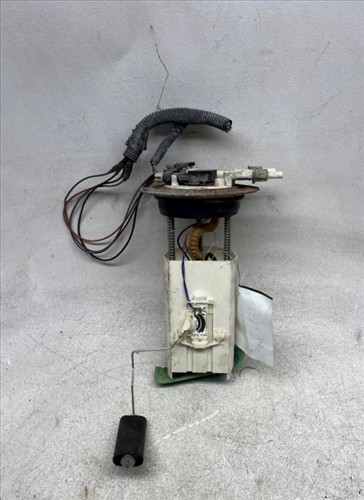
The whole assembly comes out the top of the tank as one unit — pump, level sender float arm, pressure regulator, and that same 4-pin connector up top. This one’s out of a 2000–2002 Tahoe. The white plastic yellows, the strainer sock clogs, and the float arm is fragile, so if you’re dropping the tank anyway, most people replace the complete module rather than just the pump cartridge inside it.
2000 Chevy GMC 5.3L Fuel Pump Circuit Description
Key ON, and the PCM fires the pump — that’s the two-second prime you hear from the tank. Whether it stays running depends on one thing: reference pulses from the ignition system. As long as the PCM sees the engine turning, the relay stays energized. Pulses stop — stall, crash, whatever — and the PCM cuts the pump within a couple seconds. That’s the safety shutoff on these trucks. No inertia switch, just logic.
While it’s running, the pump pushes fuel up to the rail and injectors, and the regulator holds the system between 55 and 62 psi (379–427 kPa). Anything the engine doesn’t use goes back to the tank through the return line — this is a return-style system, so fuel is circulating the whole time.
Also, with the engine off, a scan tool can command the pump on directly through the output controls function. Handy when you want to run the pump for a pressure test without cranking anything.
2000 Chevy GMC 5.3L Rated Fuel Pressure
Fuel pressure with engine OFF (ignition ON, pump running): 379–427 kPa (55–62 psi)
Fuel pressure with engine running (at idle): Lower than the engine-OFF reading. At idle, low manifold vacuum acts on the regulator diaphragm and offsets some of the spring pressure, so idle pressure should always read less than the 55–62 psi spec. It will vary slightly with barometric pressure, but if it’s not below the engine-OFF value, something’s wrong.
Lean condition: Occurs when fuel pressure drops below 379 kPa (55 psi). This can set DTCs P0131, P0151, P0171, or P0174. Symptoms include hard starting, hesitation, poor driveability, lack of power, surging, and misfire. Pressure that drops off during acceleration, cruise, or hard cornering can also cause a lean condition.
Rich condition: Occurs when fuel pressure rises above 427 kPa (62 psi). This can set DTCs P0132, P0152, P0172, or P0175. Symptoms include hard starting followed by black smoke and a strong sulfur smell from the exhaust. High pressure is caused by either a restricted fuel return pipe or a faulty fuel pressure regulator.
How the Fuel Pump Circuit Works on a 2000 Chevy GMC 5.3L
Turn the key to ON — don’t crank it — and listen near the tank. You should hear a low hum for about two seconds, then silence. That’s the pump priming. If you don’t hear it, the problem is somewhere in a circuit with exactly five stops: a fuse, a relay, a control wire from the computer, a feed wire to the tank, and a ground. That’s it.
First, the thing everyone asks: no, there’s no inertia switch. Fords have a crash shutoff with a reset button hidden in a kick panel. GM trucks of this era don’t. The safety logic lives in the PCM instead — it drops the relay a couple seconds after the engine stops turning. So if you’ve been crawling around looking for a reset button, you can stop. There isn’t one.
Schematic with the EVAP Pressure Sensor
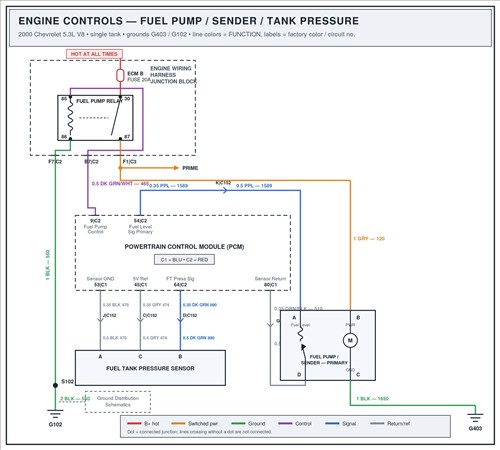
For anyone chasing a gauge problem or an EVAP code instead of a dead pump, the full schematic ties it together: the PCM pins (fuel pump control on 9, fuel level on 54, sensor return on 80), the C152 harness connector between the frame and body wiring, the fuel tank pressure sensor with its 5-volt reference, and both grounds, G102 up front and G403 at the frame.
These drawings were built for a 2000 5.3L, single tank. The same circuits carry across 1999–2002 Silverado and Sierra 1500s, and the engine-control side matches the Tahoe, Suburban, and Yukon of the same years — the tank hardware and rear grounds differ on the SUVs. From 2003 on, GM redesigned the electrical system, so don’t trust any of this past 2002. Check your year against a factory schematic before you start cutting wires.