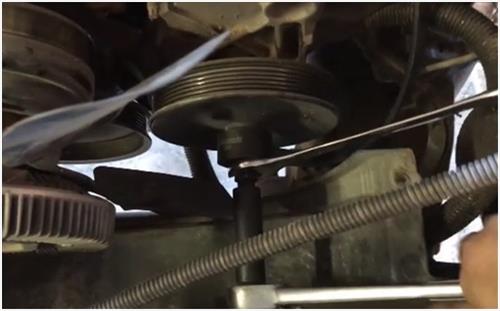
On most GM and Chevy power steering pumps the pulley is press-fit on the shaft. You cannot just unbolt it and slide it off.
Prying with screwdrivers or a 3-jaw gear puller often bends the pulley or damages the pump. The right specialty puller saves time and parts.
I have pulled, bent, and even broken these pulleys trying to force them off without the correct tool. Once you use a proper GM power steering pump pulley remover, the job takes only a few minutes.
The Performance Tool W87022 GM power steering pump pulley remover and installer is my pick for this job. It pulls by gripping the hub and pushing against the pump shaft, so force stays centered and does not wreck the pulley face.
Performance Tool W87022 on Amazon
The kit is inexpensive and usually includes these pieces:
- The bolt (forcing screw)
- The nut
- Two identical clamps
- Clamp ring
Many kits also cover install. After you swap the pump, you press the pulley back on with the installer side of the same tool. Do not hammer the pulley onto the shaft.
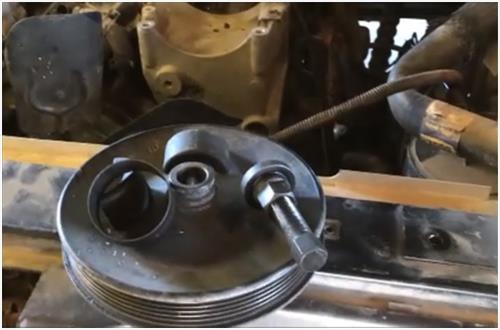
How To Remove a GM or Chevy Power Steering Pump Pulley
It helps to have the pump in a vise or well supported. Keep the tool square to the shaft the whole time.
1. Thread the bolt into the nut with the large flat washer side of the nut pointing away from the bolt head.
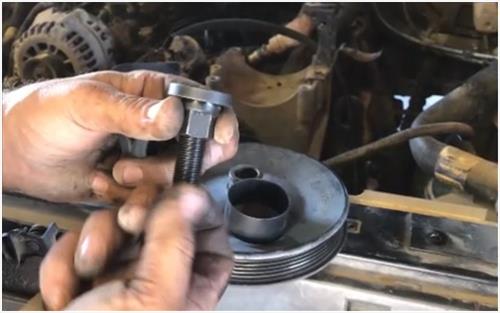
2. Look at the two identical clamps. Each has a small clamping surface and a large clamping surface.
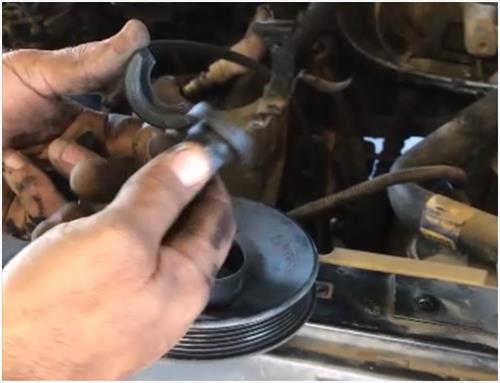
3. The large side rests against the inside of the nut. The smaller side hooks the inner lip of the pulley hub. In the photo below the pulley is already off so you can see the angle clearly.
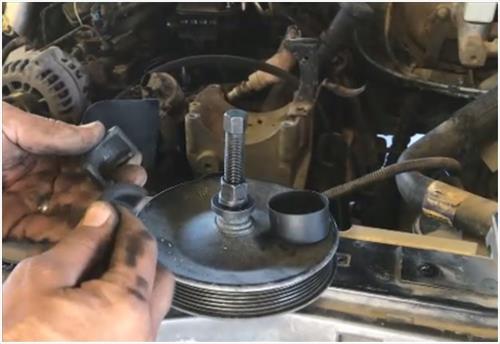
4. With both clamps in place (small side toward the pulley), snug the nut. Slide the clamp ring over the bolt, nut, and clamps so nothing spreads apart under load.
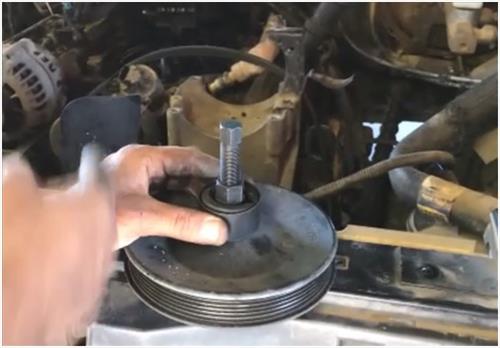
5. Hold the nut with a wrench and turn the bolt. The pulley should slide off with steady light pressure. Assembled correctly, the whole pull usually takes about 3 to 5 minutes.
Quick Tips Before You Pull
That hex (Allen) hole in the center of many GM pulleys is part of the pump shaft. It is used in manufacturing. Do not try to remove a bolt from that hole. The puller works against the shaft end, not by unscrewing anything there.
A light spray of penetrating oil on the shaft and a little oil on the tool threads helps. Keep the puller centered. If it starts to cock sideways, stop and reseat the clamps before you bend something.
This style of tool is made for press-fit power steering pulleys. A harmonic balancer puller or a common 3-jaw gear puller is the wrong choice here and can ruin the pulley.
When you are done, you have the old pulley off clean and ready to transfer to the new pump with the installer side of the kit.
Have you used the W87022 on a stubborn Chevy or GMC pump, or did another puller work better on your truck?
This site contains affiliate links for which a commission earned.
the tool that removes the pulley won’t go on the hole it’s supposed to go it to remove the pulley i’m sorta stumped on what to do
The allen hex hole is part of the pump shaft and will not come off, it is used in the manufacturing process
Do you have to remove the hex socket head (allen) bolt in the center of the pulley.
I do I’ve been trying to get mine out with no success